Lifestyle Financial Planning
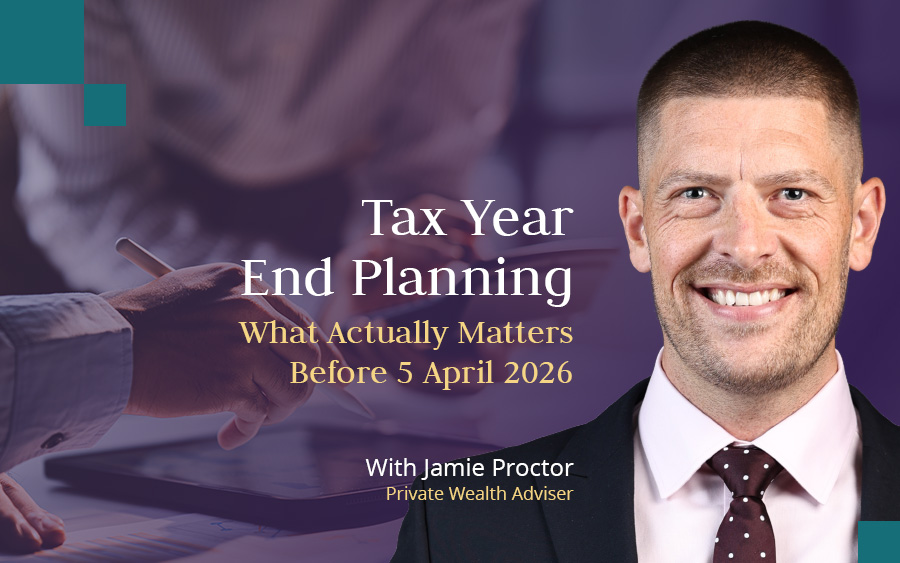
Tax Year End Planning: What Actually Matters Before 5 April 2026
The UK tax year ends on 5 April 2026. Maximise your pensions, ISAs and CGT allowances before they reset or lose them permanently.
Mar 4, 2026
.jpg)


.jpg)
The ISA is one of the most valuable tax breaks available to ordinary UK savers. It is simple in principle, generous in scale, and open to almost everyone. And every year, a great deal of it is quietly wasted.
The reasons are familiar. Most people know ISAs exist. Fewer use their full allowance. Fewer still understand that there are several different types, each designed for a different purpose, or that the allowance resets every tax year and cannot be reclaimed once it is gone.
The result is a curious situation: a worthwhile, government-provided tax advantage, available to most people, that a large proportion of savers leave only partly used. Not because they have decided against it, but because the allowance expires silently and the detail feels complicated.
This article aims to fix the second of those problems. It explains what an ISA actually is, how the £20,000 allowance works, the five types of ISA and what each is for, the particular rules around the Lifetime ISA and Junior ISA, the cash ISA changes arriving in 2027, and how to think about which ISA suits which goal. It is general information, not advice, and the right approach for any individual depends on their own circumstances.
Despite the name, an ISA is not itself an investment or a savings account in the ordinary sense. It is a wrapper.
That word, wrapper, is the key to understanding ISAs. An ISA is a tax-advantaged shell that you place savings or investments inside. The money within it is sheltered from certain UK taxes, while the underlying savings or investments behave as they otherwise would.
Specifically, money held inside an ISA is generally free of:
Outside an ISA, savings interest, dividends and capital gains can all be taxable, depending on your income and the various allowances that apply. Inside an ISA, that tax does not arise on the sheltered money, and there is nothing to declare to HMRC in respect of it.
The value of this is easy to underestimate in a single year and significant over many. A pot of savings or investments that grows year after year, entirely free of tax on its interest, dividends and gains, can end up meaningfully ahead of an identical pot held in a taxable account. That long-term, compounding tax advantage is the whole point of the ISA, and it is why using the allowance matters.
Each tax year, every UK adult has an ISA allowance. For the 2026/27 tax year, that allowance is £20,000.
This is the total amount you can pay into ISAs in the year. It can go into one type of ISA or be split across several, subject to the rules of each, but the overall total you contribute cannot exceed £20,000.
Two features of the allowance are essential to understand.
First, it resets at the start of each tax year. On 6 April, a fresh £20,000 allowance becomes available.
Second, and crucially, it cannot be carried forward. Any part of the allowance you do not use by the end of the tax year is lost. It does not roll into next year. Unlike some other allowances, there is no carry-forward and no second chance.
This use-it-or-lose-it nature is what makes the ISA allowance so easy to waste. There is no penalty for not using it, no letter, no prompt. It simply expires, quietly, every April. For savers with money that could be sheltered, that silent expiry is a small, repeated, avoidable loss, and it is the single most important reason to think about ISAs before the tax year ends rather than after.
Many people think of the ISA as a single product. In fact there are five types, each designed for a different purpose.
The first four are adult ISAs and draw on the same £20,000 allowance. The Junior ISA is separate, with its own allowance, and is covered later.
These types are genuinely different tools. A Cash ISA and a Stocks and Shares ISA suit different time horizons and carry different risks. The Lifetime ISA has its own rules and its own catch. The Innovative Finance ISA involves a particular and higher-risk form of lending that will not suit most savers and should only be considered with care and a clear understanding of the risks.
Choosing well, then, is not really about whether to use an ISA. It is about which type, or combination of types, fits the money and the goal.
The Cash ISA is the most familiar type, and the simplest. It works much like an ordinary savings account, holding cash and paying interest, with one difference: the interest is sheltered from tax inside the ISA wrapper.
The strengths of a Cash ISA are the strengths of cash generally. The balance does not fall in nominal terms, the money is accessible depending on the account type, and there is no market to worry about. For money with a job that suits cash, an emergency fund, or savings needed in the near future, a Cash ISA can be a sensible, tax-efficient home.
The limitation is also the limitation of cash generally. Over long periods, cash held at a rate below inflation can lose real spending power, even inside an ISA wrapper. The ISA shelters the interest from tax; it does not protect the money from inflation.
This means a Cash ISA is well suited to short-term and emergency money, and less obviously suited to money intended to grow over the long term. The wrapper is helpful either way, but the wrapper cannot change the underlying nature of cash. For long-term money, the question of cash versus investing still applies, and is worth weighing carefully rather than defaulting to cash simply because it feels safe.
.jpg)
The Stocks and Shares ISA holds investments rather than cash. Inside it can sit funds, shares and other investments, all sheltered from income tax on dividends and from capital gains tax on growth.
For money with a long time horizon, the Stocks and Shares ISA is the type most often relevant, because it combines two things: the long-term growth potential of investing, and the tax shelter of the ISA wrapper. Investment growth that would otherwise face tax can compound free of it, year after year.
But the Stocks and Shares ISA carries the risks of investing, and the ISA wrapper does not change that. The value of investments held within it can fall as well as rise, and you may get back less than you put in. An ISA is a tax wrapper, not a guarantee or a safety feature. A poor investment inside an ISA is still a poor investment; the wrapper simply means its returns, good or bad, are not taxed.
This is why the choice of a Stocks and Shares ISA should be made with the same care as any investment decision: a suitable time horizon, an appropriate level of risk, attention to cost, and a clear purpose for the money. The wrapper is valuable, but it sits around an investment decision rather than replacing one.
The Lifetime ISA, often shortened to LISA, is the type with the most attractive feature and the most important catch.
The attraction is a government bonus. You can pay up to £4,000 a year into a Lifetime ISA, and the government adds a 25% bonus on contributions, worth up to £1,000 a year. That is a genuine, valuable boost. The £4,000 forms part of, not on top of, the overall £20,000 ISA allowance.
The Lifetime ISA is designed for two specific purposes: buying a first home, within a property price limit, or retirement, with funds accessible without penalty from age 60. To open one, you must be aged between 18 and 39.
Now the catch. If you withdraw money from a Lifetime ISA for any reason other than a qualifying first home purchase or reaching age 60, a withdrawal charge applies. Because of how that charge is calculated, it can mean getting back less than you originally paid in, even before any investment loss. The bonus is generous, but it comes with conditions, and using a Lifetime ISA for money you might need for other purposes can be a costly mistake.
The Lifetime ISA, then, suits a specific saver with a specific goal. For the right person it is valuable; for the wrong use, the withdrawal charge is a real penalty. It is also an area where the rules may change, and any decision should be made on current rules with advice.
The Junior ISA, or JISA, is the way to save tax-efficiently on behalf of a child.
A Junior ISA can be opened for a child by a parent or guardian, and anyone can contribute to it. The allowance for the 2026/27 tax year is £9,000 per child, and, importantly, this is entirely separate from the adult £20,000 allowance. A parent can use their own £20,000 allowance and also contribute to a child's £9,000 Junior ISA allowance.
Like adult ISAs, the Junior ISA comes in cash and stocks and shares forms, and growth within it is sheltered from tax in the same way.
Two features are worth understanding. First, the money in a Junior ISA belongs to the child. It is theirs, and it cannot generally be accessed before they reach adulthood. Second, when the child turns 18, the Junior ISA becomes an adult ISA in their hands, and they gain full control of it.
For families wanting to build something for a child, perhaps towards education, a first home, or simply a financial start in adult life, the Junior ISA offers a long time horizon and a tax-free wrapper. The long horizon, in particular, is what makes it powerful, because growth has many years to compound free of tax. As with any longer-term saving, the choice between a cash and a stocks and shares Junior ISA deserves thought.
One change to the ISA rules is worth flagging clearly, because it affects how the allowance can be used.
Changes announced by the government are due to take effect from 6 April 2027. In broad terms, from that date, savers under the age of 65 will face a lower limit on how much of their annual allowance can be paid into a cash ISA, with that cash element capped below the full £20,000. The overall £20,000 ISA allowance is not being reduced; the change is about how much of it can go specifically into cash. It has also been indicated that transfers from a stocks and shares ISA into a cash ISA will be restricted.
The government has framed these changes as encouraging more long-term investing. Whether that is the right outcome is a matter of debate, and the detail is still developing, so the precise rules should be confirmed closer to the time and before publication of any guidance.
The practical point for savers is simply to be aware that the cash ISA rules are changing. Anyone whose ISA strategy currently relies heavily on cash ISAs, or who values the flexibility to move between cash and investments, should factor the 2027 changes into their planning rather than be surprised by them. It is another reason an ISA strategy benefits from being reviewed rather than left on autopilot.
With five types and one shared allowance, the practical question is how to use it. The honest answer is that it depends on the money and the goal, but a clear way of thinking helps.
The most useful approach is to match the ISA to the job of the money:
Many people sensibly use more than one type. A household might hold a Cash ISA for the emergency fund, a Stocks and Shares ISA for long-term growth, and Junior ISAs for children, all running at once.
There is no single right combination, because there is no single saver. The allowance is a tool, and the skill is in directing it according to your goals, time horizons and circumstances, rather than defaulting all of it into one familiar type.
A few mistakes recur with ISAs, and most are easily avoided once known.
The common thread is the same as with much of financial planning. The ISA itself is straightforward; the mistakes come from using it without matching it to a purpose, or from never revisiting it. An ISA strategy set up years ago, and never reviewed, may no longer fit either your goals or the current rules. Avoiding these mistakes is less about expertise than about attention.
For savers wanting to use their ISA allowance well, professional advice tends to be most valuable when it does the following.
The aim is not simply to fill an allowance. It is to use a genuinely valuable tax break deliberately, with the right type of ISA holding the right money for the right purpose.
This is why many savers find a structured conversation worthwhile, particularly given the choice of types and the changes ahead.
If you are reading this and thinking:
then the next step is usually a short, structured conversation focused on clarity. The aim is to see how your allowance is being used, match each type of ISA to a clear purpose, and make sure a valuable, renewing tax break is not quietly going to waste.
Making the most of your ISA allowance is not about:
It is about:
The ISA allowance is one of the most accessible tax advantages in the UK system, and one of the most quietly wasted. The savers who benefit most are simply those who used it deliberately, with the right type of ISA, before the tax year quietly took the allowance back.
This article is for information purposes only and does not constitute financial advice. Skybound Wealth UK is a Trading Style of Skybound Wealth Management Limited who are authorised and regulated by the Financial Conduct Authority.
While investing offers the potential for higher growth over time, it also carries risk, and the value of investments can fall as well as rise.
To find out more about this topic and more, please fill in the form below to arrange a call back.
To access a full recording of the webinar, please fill in the form below. We'll email you a link to the video.
Stay up-to-date with financial news and insights delivered straight to your inbox. Sign up today.

The value of your investment can go down as well as up and you may not get back the full amount you invested. Past performance is not a reliable indicator of future performance. Investing in shares should be regarded as a long-term investment and should fit in with your overall attitude to risk and financial circumstances.
The guidance and/or advice contained within this website are subject to the UK regulatory regime, and are therefore targeted at consumers based in the UK. Skybound Wealth UK is a trading style of Skybound Wealth Management Ltd who are authorised and regulated by the Financial Conduct Authority. Registered Office - Alum House Suite 12, Discovery Court Business Centre, 551/553 Wallisdown Road, Poole BH12 5AG. Registered Number 04479650, England. Financial Conduct Authority Number 217994.
The information contained within this site is subject to the UK regulatory regime and is therefore targeted primarily at consumers based in the UK. The Financial Ombudsman Service (FOS) is an agency for arbitrating on unresolved complaints between regulated firms and their clients. Full details of the FOS can be found on its website at www.financial-ombudsman.org.uk. Neither Skybound Wealth Management Ltd nor its representatives can be held responsible for the accuracy of the contents/information contained within the linked site(s) accessible from this page.